quarta-feira, 10 de fevereiro de 2016

Philosophical Logic of Gustavo Costa

Translated from Portuguese into English by Gustavo Costa (Duolingo: gusbemacbe)

1) What is the significance of logic in the philosophical concept and what is its importance in our daily life?  

In my philosophical concept, the logic is self-education and self-discipline that allows to analyse and study the arguments and see which ones are valid and others are invalid in order to refute, to justify, to agree and correct.   The logic is very important because it helps us to get smarter and more resistant against the arguments and the imposition of opinions contrary to our conscience, to our intelligence and our humanism.  

2) Talk about the logical thought of Heraclitus and Parmenides and why the conflict between the two logical thoughts generated in ancient Greece.

a) Heraclitus argued that the union means the disunion and the disunion means the union, which is abstract and changeable looking for a true essence, and constitutes the logic as a result of a universal law of changes, which cause disunions, which make them difficult to reconcile, and he considers it as natural, but we are in the illusion.  

b) Parmenides analysed the arguments of Heraclitus and disagreed, arguing, and proving to be a realist. He argued that the union becoming the disunion is invalid because just as the darkness does not become the light, and other pairs of opposites, light and heavy, dense and subtle, passive and active, earth and fire, hot and cold, etc. Parmenides connected to the light, or positive, and its opposite, the darkness, or negative. In this selection of opposites, Parmenides concluded that the arrangement for a free logical thought without non-fundamental intuitions is one of the characteristics for the logic.  

3) Talk about the Platonic dialectical and Aristotelian analytics and the difference between them.  

According to the source of a book of the article about the Platonic dialectics, it is quoted: “The dialectic of Plato is born from the fusion between the thesis and the antithesis, which has become a new thesis, and so on in an eternal dialectical movement of conciliation between the opposite and complementary ideas.” But according to my logical, philosophical and sociological concept, only the Platonic dialectic is impossible in some cases, such as atheists and Christians, conservatives and liberals, right followers and left followers, homosexuals and heterosexuals, do not want to reconcile, for being too narrow-minded and closed-minded and having ideas incompatible with each other and they have always had many problems and failed to solve the problems and to get ideas to agree or combine well with each other.  

So the Aristotelian logic says the contrary, here are small contributions, such as the formal separation of speeches, ideas and thoughts to analyse and validate or not, and to refute, contradict and correct what they see as invalid, which cause conflicts and confusion in people who have opposing ideas and thoughts, preventing the reconciliation between them. For example, when a Christian uses an ad hominem to attack a skeptical or scientist, giving a misinterpretation that Galileo was not burned nor condemned by the Catholic Inquisition, but the skeptical or scientist resolves to correct and refute his fallacy, presenting an original proof that Galileo was condemned anyway because he used the heliocentrism, contradicting the Bible and the Catholic Church, making the Catholic Church uncomfortable and that does not accept to be questioned.  

4) Remembering Descartes, what do you mean “I think, therefore I am”?   Reflect  

It is the certainty of doubt, I doubt everything to build closer to the rationalist certainty and the only way to get some certainty is doubting, and investigating the doubts which I am aware of myself.  

5) Why, according to Descartes, should not we completely trust in the feelings?  

Our feelings deceive us, and for deceiving us, it can not create a certainty, this is the essence of the argument of Plantinga against the naturalism.  

Descartes spoke of a mischievous intelligence that could put him in doubt about anything. The problem is that he is dualistic to admit that the mind can be separated from the body, so that he can think without bodies just thinking without existing. And if he talks about trusting the feelings, firstly they always do not succeed, and in the second, then he encouraged the non-metaphysical thought.  

6) Talk about ethics and morality and make a comparison between them.  

Ethics is bending over the morality, reflecting the morality guide while the morality guides the actions of the man stuck to his time and his place.  

7) Submit an ethical solution to the conflict between North and South Koreas.  

For the Platonic dialectics, China is still a communist country and faced the changes that have come in recent decades and prepared for them, annexed Hong Kong and Macau, which are capitalist regions, if China had reconciled with US and integrated capitalism in the country, still keeping communism or socialism, but it limits freedom and individual rights. As a result, North and South Koreas should follow the example of China and reconcile in a platonic way to resolve the conflicts and adapt to the changes. If North Korea does not want to change, North Korea will risk a lot to be wiped out in name of the morality.  

8) What is the purpose of the virtues according to Aristotle? Because they are not considered the way of the happiness?  

I consider this one of the Aristotelian the best concept of happiness. He spoke that for the person being happy, she should look for two things. Doing good and rising intellectually. Only then it reaches the true happiness. Happiness is not pleasure, is not buying a 50-inch TV.  

9) While the defects studied in class? Is it easy to fight against them? Why?  

If you are invaded by the negative feelings or negative defects as if everything was negative, then the evil is certainly inside you and you project it in order that it surround you and everything becomes bad and negative. If you remove the evil where it is really in you, you can send away and expel evil from you and you can believe in life and happiness, and you will return to love the neighbours and they will be interested in you and come back to you. Work on oneself is a difficult thing, but very positive, no other can do you in his place!  

segunda-feira, 8 de fevereiro de 2016

Special student of Computer Science tells his life history to the UNISAL


Translated into English by: Gustavo Costa (Duolingo: gusbemacbe)

Original source: http://unisal.br/aluno-especial-de-ciencia-da-computacao-conta-sua-historia-de-vida-ao-unisal/ (in Portuguese)

You also can see another interview with Gustavo Costa at Duolingo: https://www.duolingo.com/translation/873fe361f7c9be29f501c2728004ce72

In the classroom, the student of computer science of the UNISAL – Salesian University Center of São Paulo – Lorena – Campus São Joaquim, received the journalism team for an informal chat, but full of surprise.

Gustavo Reis, 26, student of the 1st year of the course, is a native of Aparecida, the Marian capital of faith, a fact that he did get used to be around people in Brazil and around the world. Perhaps for this reason he has transformed his house room in a universe of contacts and information. Gustavo is different of the other students, right away he introduced us to the world through the eyes of a special boy. The professional future was born with hearing loss, after the mother had rubella during pregnancy. Not only that scare, he presented the so-called PAC (blood persistence channel), and had to be operated. During the procedure, he stated that there was a medical mistake, which led to the loss of vision in one eye. But these hurdles only boosted him up.

The interview with the UNISAL student had to be made in written form because, unlike Gustavo, there are few who dominate the number of languages and language he knows, including sign language. See below.

UNISAL: When you became interested in computer career, specifically, the Science Course Computer?

GUSTAVO: I got interested in computers in 1998, at 9 years of age. At that time, I saw a computer of my uncle who had Windows 95 and I could not resist. It was my passport, in 2009, to explore the world and decide for my initial professions, as the graphic designer, typographer and iconographer.

UNISAL: To be a professional future you have to be connected to different cultures and languages. The Course Coordination revealed to us that in this regard you will not sin.

GUSTAVO: I can speak very well Dutch, English, French, German, Italian, Portuguese, Spanish and Brazilian sign language. Still studying German and Dutch, in addition of Hebrew, Japanese, Romanian, Russian and 4 foreign languages signs. In 2004, at age 15, I was a teacher of French and Italian at the farm “Desafio Jovem Ebenézer, in Jacareí (SP). I have also acted as translator.

UNISAL: One of your teachers, Luiz Carlos Rosa, told us that you have a greater sense of awareness that many students do not. How and who taught you to explore the world in other ways?

GUSTAVO: My challenges were and will always be self-taught and persistence. Charles Chaplin said: “Persistence is the way of success.” I think this saying is all about me, but I quickly tell my career. I started learning English when my aunt gave me an English book at 10 years old. My stepfather also had an English dictionary and photos of trips he made to Chile, the Caribbean Islands and the United States. Also, I had a teacher who introduced me to the first English classes in the 4th year of primary school. Soon my family discovered my interest in other cultures and, from there, my gifts were always dictionaries and books, French, German, Italian, Japanese and Spanish. I started studying Spanish, French and English when I started 5th year, at age 12. At age 13, I began to study German and Italian. In 2008, I started the Japanese studies.

UNISAL: How do you practice the language on a daily basis?

GUSTAVO: It depends on a person’s language, skill, time, determination and limit. I always started with the dictionaries and then with the grammar. Then I practiced the writing of various countries in order to improve and become fluent in every language. I managed to study many languages at the same time. But it depends on the person and the tongue. I have a family that supports me, not only in the projects but also in the sign language. My world is not silent.

UNISAL: What are the plans of Gustavo for the future?

GUSTAVO: I want to be graduated to be a programmer and to return to work as a translator and graphic designer. Also, I think about graduate school and master’s degree in Computer Science. In the future, I also want to study Astronomy and Aerospace Engineering.

UNISAL: What reasons led you to choose the UNISAL?

GUSTAVO: The UNISAL is a clean and organised educational institution.

UNISAL: You can leave a message for our readers?

GUSTAVO: It does not matter if you are poor, black, white or brown. Always remember the saying to which I turn too: “If you think there’s no use, because your life is difficult. Even hard, but insist and be persistent.” (Augusto Cury)

sábado, 6 de fevereiro de 2016

Interview with Gustavo Costa – A Brazilian polyglot deaf-born man

Hello students of Dutch and Dutch people!


My name is Gustavo Costa.


I am Brazilian, deaf from birth, freelance graphic (web) designer, type designer and translator and Computer Science student and 26 years old.


I am Brazilian, deaf-born, freelance graphic (web) designer, type designer and translator and science student and 26 years old.


I speak Portuguese, French, English, Spanish, Italian and Brazilian sign language. I am learning German, Esperanto, Hebrew, Japanese, Dutch, Russian, Turkish and four foreign sign languages. I will learn a lot of languages. I can not say why I want to learn many languages. It is my secret. Sorry!


I love astronomy, designing, geography, history, Japanese food, mathematics, philosophy, physics, psychology, reading, programming, swimming.


I love reading encyclopedias to collect more erudition, intellect and knowledge, I also like to be informed about the technology (computers, artificial intelligence, programming languages, robot, smart phone, etc.). I like to learn anything new, learning languages, going to the mall to buy elegant and posh clothing (suits, vests, etc.), watching science fiction movies, going to the gym, playing with the terminal of Linux and Mac OS X, to collect graphic design staffs, grammar books, fonts and dictionaries.


I am a born charismatic and flirtatious. I have many personality and characteristics (negative, neutral and positive): aggressive, affectionate, adventurous, attentive, boring, charming, childish, classy, compulsive, concentrated, conscientious, cooperative, courageous, crazy, creative, critical, cultivated, dedicated, doubtful, dramatic, elegant, empathetic, enthusiastic, erudite, exciting, extrovert, free-thinking, friendly, formal, galant, generous, helpful, humorous, hypnotic, independent, industrious, individualistic, intellectual, ironic, knowledgeable, lazy, mindful, objective, open, open-minded, organised, patient, perfectionist, persuasive, politically conscious, posh, provocative, quarrelsome, rational, refined, romantic, sarcastic, scientific, self-confident, serious, sociable, stubborn, subtle, tolerant.


I am admirer of Apple, Google and Linux. I do not like Windows.


Nice to meet you!

sábado, 9 de janeiro de 2016

Blagues drôles de Gustavo Costa

Blague 1

Trois coureurs de jupons se rencontrent chez leur ami et racontent comment ils ont couru après les femmes. Ils questionnent les deux premiers :

Combien de femmes as-tu couru hier ?
- 4 femmes, a déclaré le premier.

Deux questionnent au second :
- Combien d’elles as-tu couru hier ?
- 2 femmes, a déclaré le second.

Enfin, le troisième est questionné :
- Combien de femmes as-tu couru hier ?
- Une ... une poupée gonflable.

Blagues 2

Un couple brésilien a fait un voyage de noces à Paris et sont venus à un restaurant chic, cher et romantique appelé Le Meurice dans 8e arrondissement, que se trouve dans la rue de Rivoli, dans le Jardin des Tuileries, à proximité du Musée du Louvre. Ils assoient et appellent un garçon non préparé qui mal comprend l’anglais.

— S'il vous plaît deux raviolis verts non fricassés d'escargots et deux poulets marinés et cuits deux au chou rouge. Deux jus de pomme, dit l'homme.
— Oui, monsieur et madame. On vous apporte de la nourriture. S'il vous plaît, attendez.

Après 10 minutes…

Le serveur a apporté de la nourriture pour le couple.

La femme ouvre le couvercle de métal et a crié :
— Deux grenouilles et deux escargots !

Blagues 3

Homme funk : Pourquoi portes-tu les vêtements élégants pour aller avec moi au centre commercial ?

BCBG : Parce que je suis. C’est mon autodéfiniton et ma personnalité. Y a-t-il des problèmes ?

Homme funk : Allez en France et aux Pays-Bas ! Ici est le Brésil !

BCBG : Vous oubliez que je vous traite bien et vous me maltraitez seulement parce que je suis élégant ? Je ne me change pas pour vous plaire. Allez en Jamaïque !

Homme funk : Tu as raison. Je remplacerai pour les vêtements de rappeur.
(Il pense que le rap est une culture jamaïcaine)


sexta-feira, 1 de janeiro de 2016

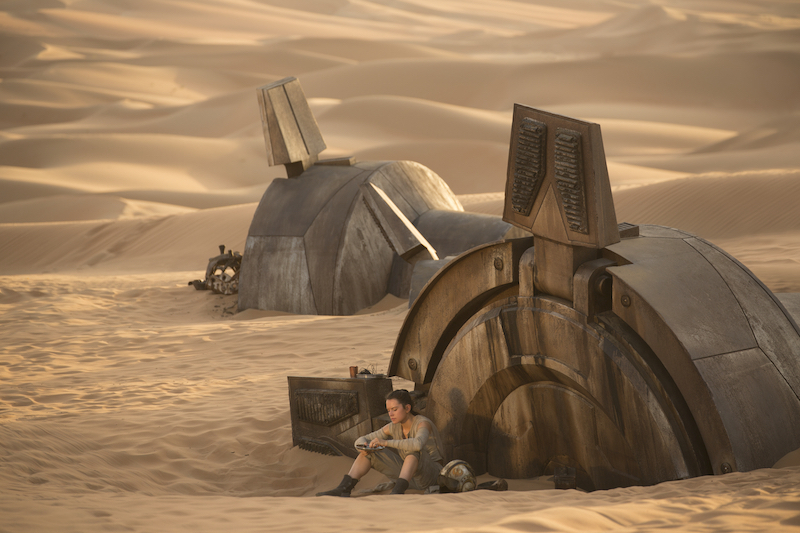
Rey — Star Wars


Rey est une charognard de la planète Jakku, une survivante trempée par la vie sur une planète désertique éblouissante. Lorsque le droïde fugitif BB-8 fait appel à elle pour l'aide, Rey se retrouve tirée dans un conflit de galaxie traversée. Malgré qu'elle se rejète comme « nulle », elle apprend que sa vie est façonnée par le pouvoir mystérieux de la Force.

PROFIL DE LA REY


Apparitions : Star Wars, épisode VII : Le Réveil de la Force

Lieux : Jakku

Sexe : Femme

Hauteur : 1,7 mètres

Espèce : Humaine

Véhicules : Moto-volant de Rey

Armes : Pistolet à boutefeu, Sabrolaser

HISTORY

Le Premier Ordre


Rey a grandi sur Jakku, obtenant avec son effort une vie comme une charognard et en espérant qu'un jour, ceux qui l'avaient laissé sur le monde de désert sec reviendraient. Elle a appris à survivre, devenir mécanicienne, pilote et guerrière douée. Mais elle semblait destinée à vivre ses jours sur un monde de remous sans espoir, ignorante de la galaxie plus grande et ses périls et possibilités.


La vie de Rey a changé quand elle a rencontré BB-8, un astromécano de la Résistance portant une carte des étoiles en offrant un indice à la localisaiton du maître Jedi perdu depuis longtemps, Luke Skywalker. Rey et le stormtrooper apostat Finn ont forgé une amitié improbable, échappant de Jakku et se retrouvant pris dans une guerre galactique — avec leurs deux destins façonnés par le pouvoir réveillé de la Force.